
Reviewed · ALBAICIN & SACROMONTE TOURS
Albayzin and Sacromonte Guided Walking Tour in Granada
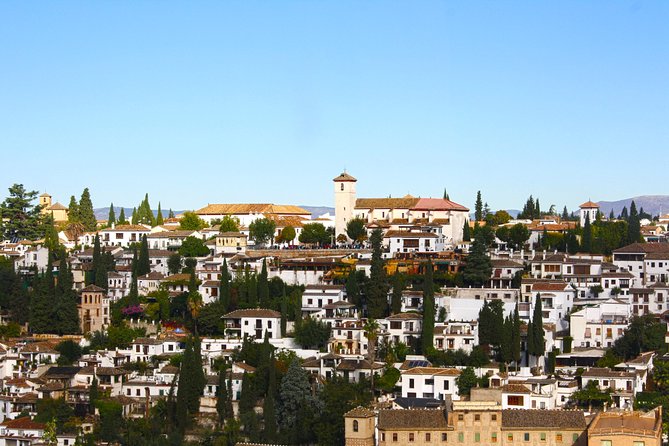
Granada’s best views come with a price: uphill walking. This tour leads you from Plaza de Isabel la Católica through the old Albayzín and onward to Sacromonte, where cave homes, flamenco venues, and Roma traditions give the city a very different face. I like the way it connects Moorish Granada with modern daily life, rather than treating the neighborhoods as a string of pretty streets. I also like the late afternoon start, which avoids the worst heat and leaves you at Mirador de San Nicolás as the day softens.
The catch is simple and important: this is not an easy stroll. You will face steep lanes, stairs, and uneven cobblestones, and one large group had trouble hearing the guide without headsets. The price, about $16.93 per person, is excellent for a well-led introduction, but you need sound shoes, water, and a reasonable level of fitness.
In This Review
- Key points to know before you book
- Why this walk reveals more than a map can
- Starting at Plaza de Isabel la Católica
- Paseo de los Tristes and the first Alhambra view
- Albayzín’s lanes, houses, churches, and fountains
- Sacromonte and the cave homes
- Mirador de San Nicolás, the grand finish
- How hard is the walking?
- The guide makes or breaks the experience
- Is $16.93 good value?
- Who should book this Granada walk?
- Should you book it?
- FAQ
- How long does the Albayzín and Sacromonte tour last?
- Where does the tour start?
- Where does the tour finish?
- What time does the tour begin?
- Is hotel pickup included?
- Are food and drinks included?
- Is the tour offered in English?
- Is the walk suitable for most people?
- What happens if I need to cancel?
Key points to know before you book
- Alhambra views from several angles: Paseo de los Tristes and Mirador de San Nicolás provide memorable views across the valley.
- Two historic districts in one walk: You see Albayzín’s Moorish streets and Sacromonte’s cave quarter in one outing.
- Guides add real character: Irene, Maria, Marco, Juana, Francisco, and others have been praised for clear stories, humor, and warmth.
- Expect hills and stairs: The route is strenuous in places, with cobbles and steep climbs.
- A useful evening start: The 5 p.m. departure gives you cooler conditions than a midday walk.
- The finish is not the start: The walk ends near Mirador de San Nicolás, so ask the guide how to get back to central Granada.
Why this walk reveals more than a map can
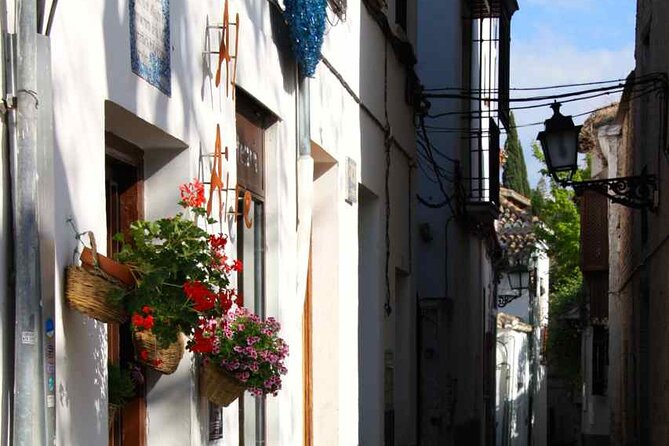
You can wander Albayzín on your own, but the district is easy to experience only as a maze of white walls and attractive doorways. A guide helps you notice the details you would otherwise pass: old gates, Moorish remains, churches built over earlier structures, fountains, balconies filled with flowers, and the shape of the streets themselves.
That context is the main reason to book. The walk is not focused on entering major monuments. Instead, it explains how Granada grew, how Moorish and Andalusian buildings share the same hillsides, and how the city’s communities shaped these neighborhoods over the centuries.
The route also gives you a useful orientation early in your stay. Several guides have offered suggestions for places to eat and sights to visit later, and one guide arranged a look inside a cave house and special access to a flamenco cave venue. Those extras may depend on the guide and the day, so do not treat them as guaranteed inclusions. The professional guide is included, but food, drinks, transport, and entrance fees are not.
More walks through the Albaicin and Sacromonte:
- Granada: Albaicín and Sacromonte Guided Sunset Walking Tour
★ 4.9 · 2,962 reviews - Sacromonte: Flamenco Show at Cuevas Los Tarantos Tickets
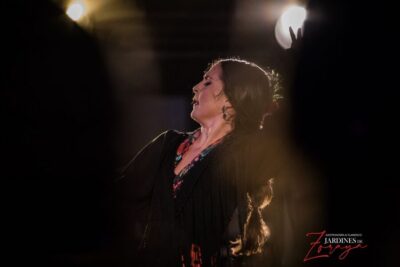
★ 4.5 · 2,051 reviews - Granada: Flamenco Show in Albaycin – Jardines de Zoraya
★ 4.7 · 1,234 reviews
Starting at Plaza de Isabel la Católica
The meeting point is Plaza de Isabel la Católica, in central Granada near the Cathedral. This is a practical place to begin because it is easy to find and close to public transportation. The square also gives your guide room to gather the group before the climb begins.
From here, the tour introduces Granada’s royal and civic story. You may pause near important buildings connected with the Catholic Monarchs, including the Chancillería, which served as the High Court of Justice from their period. The point is not a long museum-style lecture. It is a quick framework for understanding the city before you leave the center.
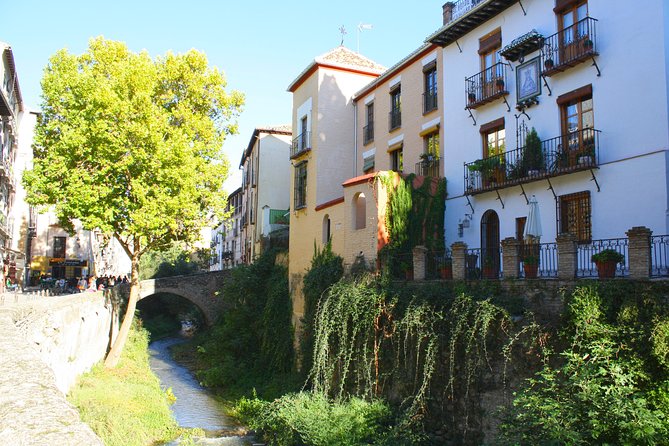
The route then heads toward the Darro River and one of Granada’s most picturesque roads. This transition matters. The busy central streets give way to a quieter, older part of town, and the Alhambra begins to appear across the water and up the opposite hill.
Paseo de los Tristes and the first Alhambra view
Paseo de los Tristes is one of the tour’s short but effective stops. Near the Darro, you get an early look toward the Alhambra, with the river corridor helping you understand the relationship between the palace complex and the old neighborhoods opposite it.
This is also where the uphill work begins. The route climbs from the river toward the Albayzín, so you should not expect a level riverside walk followed by a gentle wander. The five-minute stop listed for Paseo de los Tristes is mainly for the view and orientation, not a long rest.
I like this part because the climb has a purpose. You are not simply trudging up a hill. You are moving into the medieval quarter while watching Granada change around you. Still, if you have knee problems or dislike stairs, this is the moment to take the warning seriously.
Albayzín’s lanes, houses, churches, and fountains
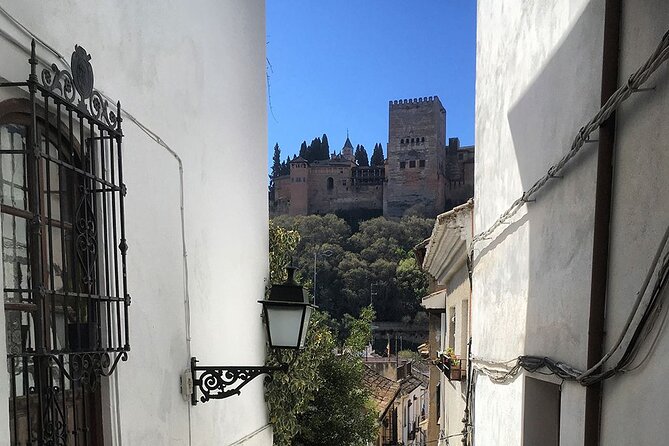
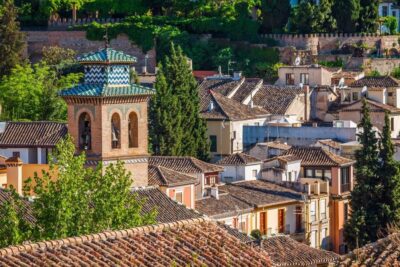
Albayzín occupies the hill facing the Alhambra and forms the heart of medieval Granada. Its narrow, twisting streets can feel confusing, but that is part of the experience. The route takes you through whitewashed houses, small squares, old churches, fountains, and lanes where the city’s Moorish past remains visible in the layout.
The white walls are only the surface. Look for enclosed courtyards, balconies, old stonework, and the way the streets rise and bend with the hill. Your guide can connect these ordinary-looking features to the neighborhood’s 11th-century origins and later Andalusian changes.
Several guides have been praised for making architecture and history easy to follow. Irene was noted for adjusting her pace to the group and sharing personal experiences. Arina used humor with her explanations, while Maria kept the stair climb light and answered questions along the way. You may have a different guide, but the strongest part of this operation is clearly the human interpretation.
The main limitation is sound. Groups can reach as many as 30 people, and one larger group found it difficult to hear over outside noise. Smaller departures have been much easier for conversation, with one group numbering only six people. If your booking offers a small-group option, I would consider it worth paying extra for. A microphone and listening devices would also improve the experience on crowded streets, but they are not listed as included.
More guided walks on foot:
- Guided Walking Tour of the Alhambra in Granada
★ 4.0 · 863 reviews - Granada: Albaicín and Sacromonte 2.5-Hour Walking Tour
★ 4.7 · 777 reviews - Granada: Albaicín and Sacromonte Walking Tour
★ 4.5 · 665 reviews - Granada’s Hidden Treasures: Albayzin and Sacromonte Walking Tour
★ 4.5 · 575 reviews
Sacromonte and the cave homes
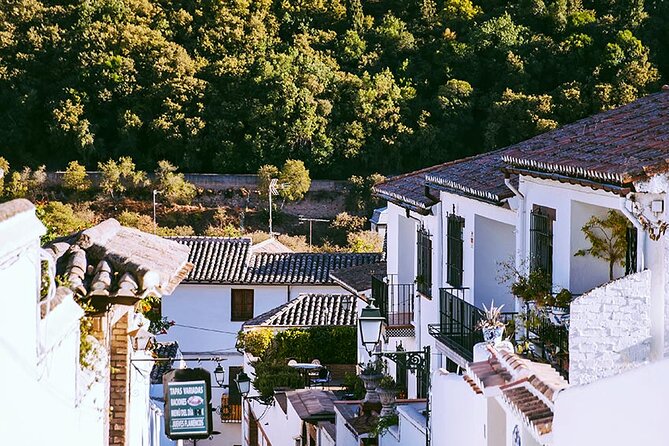
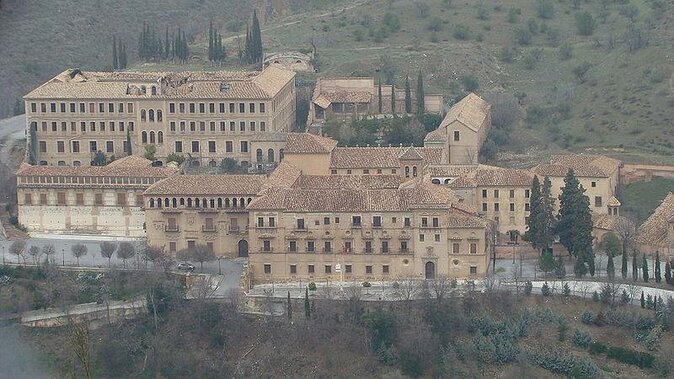
From Albayzín, the route continues east to Sacromonte. This district is associated with Granada’s Roma community, whose presence here dates to the late 15th century. It is known for homes cut into the hillside, many of them formed in rock and adapted over time.
The walk around Sacromonte adds a social and cultural layer that you will not get from Albayzín alone. You may see traditional caves still used as homes, along with cave venues that now serve as flamenco bars or small museums. Some display household objects, crafts, and details of earlier cave life.
The word gypsy appears in the tour description, but the more respectful modern term is Roma. A good guide should explain the community’s place in Granada without reducing it to flamenco stereotypes. Juana received particular praise for discussing the history of Granada, Spain, empire, and the struggles of Roma people with both feeling and precision. That kind of wider context makes the Sacromonte section much more valuable than a quick photo stop.
The cave homes are also a reminder that Granada’s past is not confined to palaces. People adapted the hillsides to everyday needs, and some of those spaces remain part of local life. You may not enter a cave on every departure, since the advertised inclusion is a guide rather than admission to a cave museum. Still, a visit has been arranged on some walks, so it is reasonable to ask at the start.
Mirador de San Nicolás, the grand finish
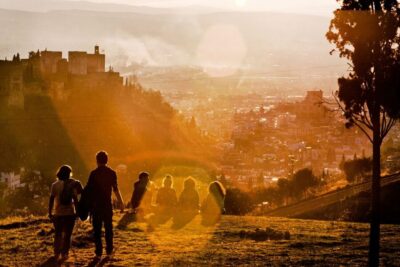
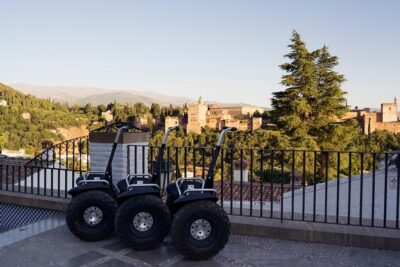
The walk ends at Calle Mirador de San Nicolás, near the famous viewpoint of the same name. From here, the Alhambra fills the view across the valley, backed by the Sierra Nevada on clear days. This is the place for the classic Granada photograph, but it is also a useful moment to grasp the city’s layout.
The Alhambra sits across from the Albayzín, while Sacromonte stretches farther east. After walking between these districts, the view becomes more than a postcard. You understand the hills, the river corridor, and the way Granada’s historic quarters face one another.
The listed stop at the viewpoint lasts about 10 minutes, although the tour may finish nearby rather than return to the central meeting point. One person expected to be escorted back and found the early finish inconvenient. Ask the guide before setting off where the walk will end and how you should return.
The viewpoint can be crowded, especially at popular sunset hours. The 5 p.m. departure does not guarantee sunset at the finish, since the season changes the light and the walking pace varies. It does put you in the right part of town for an evening view, though, and you can remain afterward if you want more time.
How hard is the walking?
I would rate this as moderate to strenuous, depending on your usual walking habits and the weather. The route includes hills, stairs, and uneven cobblestones. Several people found it perfectly manageable when the guide slowed down and offered breaks, while another person stopped after roughly half an hour because the pace and climbs were too much.
You do not need to be an athlete. You do need to be comfortable walking uphill for an extended period and stepping carefully on irregular surfaces. Children have enjoyed the tour, including a family with children aged 10 and 12, but every member of your party should be ready for the physical side.
Wear shoes with a firm sole. Sandals with poor grip are a bad choice, and smooth city shoes can be awkward on sloping cobbles. Bring water, especially in summer. There is no food or drink included, and one person specifically wished for a restroom break during a hot walk.
The tour operates in all weather. In warm months, the late afternoon start is a sensible choice, but heat can still be intense on the climb. In cooler or wet weather, dress for changing conditions. The tour is not described as wheelchair accessible, and the stairs and cobbles make it unsuitable for many mobility limitations.
The guide makes or breaks the experience
The route is worthwhile on its own, but the guide determines how much you take away. The best reports describe guides who speak with warmth, involve the group, answer questions, and connect past events with life in the neighborhoods today.
Names that have earned especially strong praise include Irene, Maria, Marco, Juana, Arina, Francisco, Elena, Carmen, Elaine, and Mar. Marco has been credited with offering extra cave and flamenco access. Francisco kept a family engaged while answering questions about Granada and Spain. Mar made the climbs more manageable by keeping the pace open to the whole group.
That said, guide quality and group conditions can vary. One English-booked departure included Spanish-speaking participants, and the guide spent more than half the time speaking Spanish. If you are booking an English departure, confirm the language at the meeting point and speak up early if explanations become difficult to follow.
The maximum group size is 30. That is manageable on open streets, but less ideal in noisy lanes. A small group gives you a much better chance to ask questions and hear the stories.
Is $16.93 good value?
Yes, provided you want interpretation rather than a private tour or monument admission. At about $16.93, the cost is low for two to two and a half hours with a professional guide in two of Granada’s most distinctive districts.
You are paying for orientation, local context, and a route that can be confusing to piece together alone. You are not paying for food, drinks, hotel pickup, or guaranteed entrance to cave museums or flamenco shows. The tour also does not replace a timed visit to the Alhambra Palace. Think of it as a neighborhood introduction that helps you see Granada with sharper eyes.
The value is strongest at the start of a stay. Take notes when the guide recommends other places to see or eat, then use the rest of your time to return to the spots that caught your attention. If you already know Albayzín and Sacromonte well, the basic route may feel less necessary.
You can cancel for a full refund up to 24 hours before the start time. Changes or cancellations inside that window are not accepted for a refund. The experience also requires a minimum number of participants, and if the operator cancels for that reason, you are offered another date or a full refund.
Who should book this Granada walk?
I would choose this tour if you want a clear introduction to Granada’s old quarters, enjoy local history, and prefer walking streets to sitting on a bus. It suits first-time visitors, families with older children, and anyone who wants to understand the Alhambra’s setting before or after visiting the palace.
It is also a good match if you care about culture beyond grand monuments. Sacromonte’s cave homes and Roma traditions add a human side to the city, while Albayzín shows how Moorish street patterns still shape daily movement.
I would think twice if you have limited stamina, need a level route, or want a quiet, slow photography walk. I would also avoid booking it immediately after a demanding Alhambra visit. The hills may be beautiful, but they do not become flatter because you have already walked all morning.
Should you book it?
Book this tour if you can handle hills and want the story behind Granada’s most atmospheric neighborhoods. The low price, strong guides, Alhambra viewpoints, and access to Albayzín and Sacromonte make it a smart introduction.
Choose a small-group departure if possible, bring water, wear proper shoes, and confirm the meeting point and finishing place. If the group is large or the guide speaks in more than one language, the experience may lose some detail. For most visitors who want history, views, and a close look at everyday Granada, this is money well spent.
FAQ
How long does the Albayzín and Sacromonte tour last?
The experience is described as lasting about two to two and a half hours. The highlights and walking plan refer to approximately two and a half hours.
Where does the tour start?
It starts at Plaza de Isabel la Católica in central Granada, near the Cathedral.
Where does the tour finish?
The listed end point is Calle Mirador de San Nicolás in the Albayzín. The tour may finish at another nearby point, so ask the guide before the walk starts.
What time does the tour begin?
The scheduled start time is 5 p.m.
Is hotel pickup included?
No. Hotel pickup is not included.
Are food and drinks included?
No. You need to bring or purchase your own food and drinks.
Is the tour offered in English?
Yes. The tour is offered in English, though you should confirm the language at the meeting point if the group includes people booking other language options.
Is the walk suitable for most people?
Most people can participate, but you need to manage hills, stairs, and uneven cobblestones. The route can be strenuous, especially in hot weather.
What happens if I need to cancel?
You can cancel for a full refund at least 24 hours before the local start time. Cancellations or changes made less than 24 hours before the start are not refunded.
Just added around Granada
- Granada: Alhambra tickets and other attractions★ 5.0 · 3 reviews
- Antequera and Torcal from Granada in a small group up to 7 people★ 4.5 · 3 reviews
- Granada Private Tapas & Walking Tour★ 4.5 · 3 reviews
- Albaicin and Sacromonte Private Tour★ 4.5 · 3 reviews
- Complete Private Tour of Alhambra with Nasrid Palaces★ 4.5 · 3 reviews
- Sierra Nevada Small Group BIKE Tour★ 5.0 · 3 reviews
- Private Tour of the Alhambra★ 5.0 · 3 reviews
- Granada: Guided Albaicín Visit with Pets★ 5.0 · 3 reviews
Albaicin & Sacromonte Tours, compared.
Albaicín and Sacromonte Guided Sunset Walking Tour
Read our review →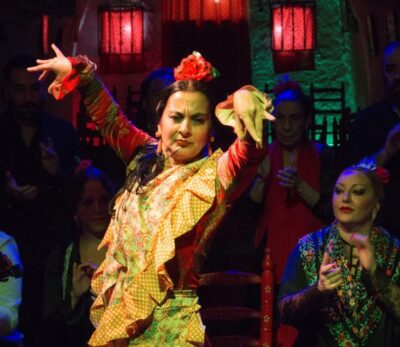
Flamenco Show in Albaycin – Jardines de Zoraya
Read our review →
Albaicin & Sacramonte Electric Bike Tour in Granada
Read our review →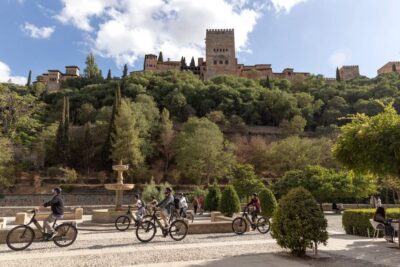
Browse the lists this tour appears in